
CANTILEVER RACKING
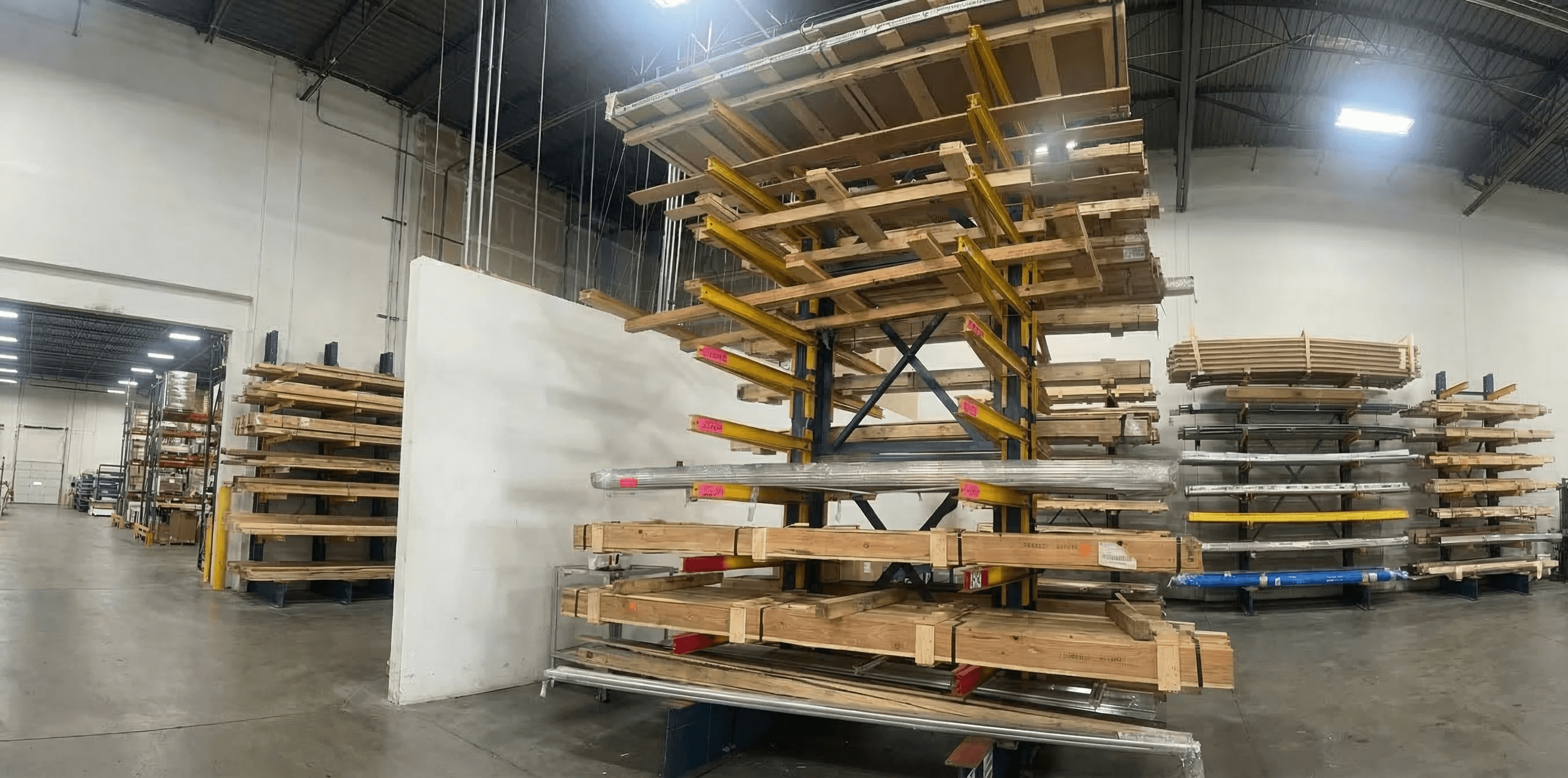
The go-to solution for long, bulky, or irregular materials. Cantilever racking is designed for items that don’t fit on traditional pallet racks, like lumber, pipes, or oversized products.
With open-front arms instead of standard beams, it allows easy access and efficient storage for long loads. Commonly used in lumber yards, metal storage, and manufacturing environments.
Built to handle heavy, oversized loads
Cantilever racking is designed to support long and heavy materials with ease.
Typical capacities range from:
500–2,000 lbs per arm (light-duty)
2,000–5,000 lbs per arm (medium-duty)
Up to 20,000+ lbs per column (structural systems)
Capacity varies based on arm length, column height, and overall configuration.
Fast access, zero obstructions
With no front columns, cantilever racks provide completely open access to stored materials.
*This makes loading and unloading faster and more efficient using forklifts, side loaders, or manual handling—especially for long or irregular items
Designed to fit your space
Cantilever systems can be adapted to different layouts and storage needs:
Single-sided racks against walls
Double-sided racks for central aisles
High-density setups for lumber or pipe
Outdoor systems with weather-resistant finishes

What makes up a Cantilever system?
A cantilever rack is made up of key structural components that work together to support long, heavy loads safely.
Vertical columns (the backbone)
Columns are the main supports of the system.
Structural steel construction
Heights typically from 8 ft to 30 ft
Mounted on heavy-duty bases
Support multiple adjustable arms
They define the overall height and load capacity.
Arms (where the load sits)
Arms extend from the columns to hold materials.
Common lengths:
24”, 36”, 42”, 48”, 60”
They are adjustable in small vertical increments, making it easy to adapt to different product sizes.
Bases (stability at ground level)
Bases anchor the system and provide structural support.
Typical sizes:
24”, 36”, 48”, 60”
Longer bases are used for heavier and longer loads.
Bracing (keeping everything solid)
Bracing connects columns to maintain stability.
Horizontal braces
Diagonal braces
These components ensure the system can safely support heavy materials.
The go-to for long material storage
Cantilever racking is widely used for storing:
Lumber and wood products
Steel bars and tubing
Pipes and conduit
Furniture and large panels
Construction materials
Its open design and structural strength make it one of the most efficient solutions for oversized inventory.
A typical setup
A standard configuration might look like:
16 ft column height
48” arm length
4 storage levels
Up to 10,000+ lbs per column
(Depending on design and load requirements)